
01
Operating budget development
Department request entry, multi-year actuals pull, county-wide rollup without spreadsheet consolidation, versioning, and in-platform leadership review.
Adams County, Colorado, a cloud-based budgeting platform across the full budget lifecycle. This is a Request for Information, no award and no contract. Techtiz writes the response and builds the platform behind a US prime who owns the agency relationship.

A formal RFI. Written questions go to the contact by June 12. Responses are accepted electronically only, through the platform, and anything after 3:00 PM MT on June 22 is not accepted.
Issued
Published on the platform, 12:39 PM EDT
Questions due, 5 PM MDT
By email to Rebekah Zamora-Arroyo
Responses due, 3 PM MT
Electronic only via ccionline.org. No late entries
Possible RFP
A future RFP may follow, not guaranteed, subject to County budget approval
25 days from issue to response, tight for an RFI of this scope. Today the clock is running.
This is information-gathering. Reading it any other way wastes effort or anchors a future bid badly.
Three data flows define the fit: actuals pulled near real time for budget-to-actual, chart of accounts periodically, and position data event-driven. Identifying the County's ERP before responding is the largest single advantage available; comparable Colorado counties run Tyler, SAP, or Oracle environments. The close second is the 10-year CIP and long-range planning horizon, which narrows the real field well below the 55-plus downloaders, because many platforms stop at a 5-year window. Domain understanding shows by naming the ERP concretely, not by checking a feature box.
The boundary that keeps a Subcontracting model clean on a public-sector data engagement.
Practical, not statutory. This RFI contains no offshore restriction and no NDA requirement, which is expected for an information-gathering document. The gates here are forward-looking. County IT will not grant offshore access to internal systems, any work involving county data is handled by the US prime or US-based team members, and the prime owns the relationship under a mutual NDA. At the RFI stage almost no county data is in play, so the offshore lane is wide. The gates bind once county data and ERP access enter at the RFP and contract stage.
Read and index the full RFI
Draft the response sections that map each capability area to a platform feature
Research the County's unnamed ERP through public records and vendor rosters
Develop the indicative pricing range with low, mid, and high scenarios and flagged assumptions
Prepare comparable county-government reference summaries from the prime's own client data
Draft the SSO description naming identity providers and protocols, SAML 2.0, OAuth 2.0, OpenID Connect
Prepare the demonstration environment on vendor-hosted or synthetic data
Build and configure the platform against synthetic or vendor-hosted environments
Any access to the County ERP environment
Any handling of county financial data
Direct communication with Adams County
Signing and submitting the response on the platform
Holding any future contract as prime
Gates, stated plainly. A mutual NDA covers the RFI contents, the internal pricing and strategy, and the analytical work product, with a term of at least three years, governed by the law of the prime's state of incorporation, not offshore law. No offshore access to county systems or county-proprietary data at any stage. The prime reviews and submits all client-facing material.
An RFI has no scoring, so none of these is pass or fail. They are the moves that get remembered when the RFP committee assembles.
Responding as if this were an RFP, with firm commitments and over-built detail, mistakes information-gathering for a competition.
Over-investing as if an RFP were guaranteed burns effort. Calibrate the response to shape the RFP, not to win a contract that does not exist yet.
An RFI carries no weights and no award. The split below is the Collab P analyst estimate of where a strong response should concentrate, not an Adams County criterion. Eligibility is simply qualified organizations with experience in public-sector budgeting software, and there are no pass-or-fail gates.
These percentages are an internal framing aid, not official weights. Where this estimate and the RFI differ, the RFI governs. The RFI itself states no scoring and makes no award.
The platform covers eight capability areas. ERP integration is the technical hook the whole response turns on.
Department request entry, multi-year actuals pull, county-wide rollup without spreadsheet consolidation, versioning, and in-platform leadership review.
Salary and benefits modeling across years, step and cost-of-living changes, new-position costs, funded-versus-unfunded status, cross-fund allocation.
Project entry, prioritization, multi-year carryforward and reappropriation, operating-impact capture, and a 10-year CIP outlook with visualization.
What-if modeling, side-by-side scenario comparison, and 10-year long-range forecasting of operating budgets, personnel, capital, and fund balances.
Structured submission, routing, and approval, with a clear one-time versus ongoing distinction.
Budget-to-actual, variance, drill-down, dashboards, and a public-facing adopted-budget and capital-plan view.
Pull actual expenditure data, chart of accounts, and position data from the County's ERP, reducing manual entry. The ERP is not named.
Organizational credentials via SAML 2.0, OAuth 2.0, and OpenID Connect. County IT treats SSO as a core security control.
No budget is stated, and no pricing is binding. The ranges below are Collab P pre-bid estimates derived from scope, not county figures. ERP integration cost is the variable that most affects a future win.
Plus about $70k per year SaaS. Assumes a pre-built ERP connector and light customization.
Plus about $100k per year SaaS. Custom ERP integration, multi-year data migration, training for 50 to 100 county users. Model under NDA
Plus about $140k per year SaaS. Legacy decommission, a non-standard ERP, phased rollout, and heavy change management.
Industry-standard security and public-sector data management, in the language county IT reads. Governing law is Colorado; any future RFP would likely cite Title 29 and County purchasing regulations.
The control-attestation baseline for a hosted public-sector platform.
Accessibility for the admin console and the public-facing budget view.
Encryption at rest and in transit across the platform.
A hosting preference that matters to a Colorado county buyer.
Single Sign-On on organizational credentials, treated as a core control.
Full audit trail for budget changes, approvals, and adjustments.
Data retention, backup, and recovery commitments described in the response.
Colorado Revised Statutes Title 29 and County purchasing rules, venue in Adams County District Court. The municipal default; no code is cited in the RFI itself.
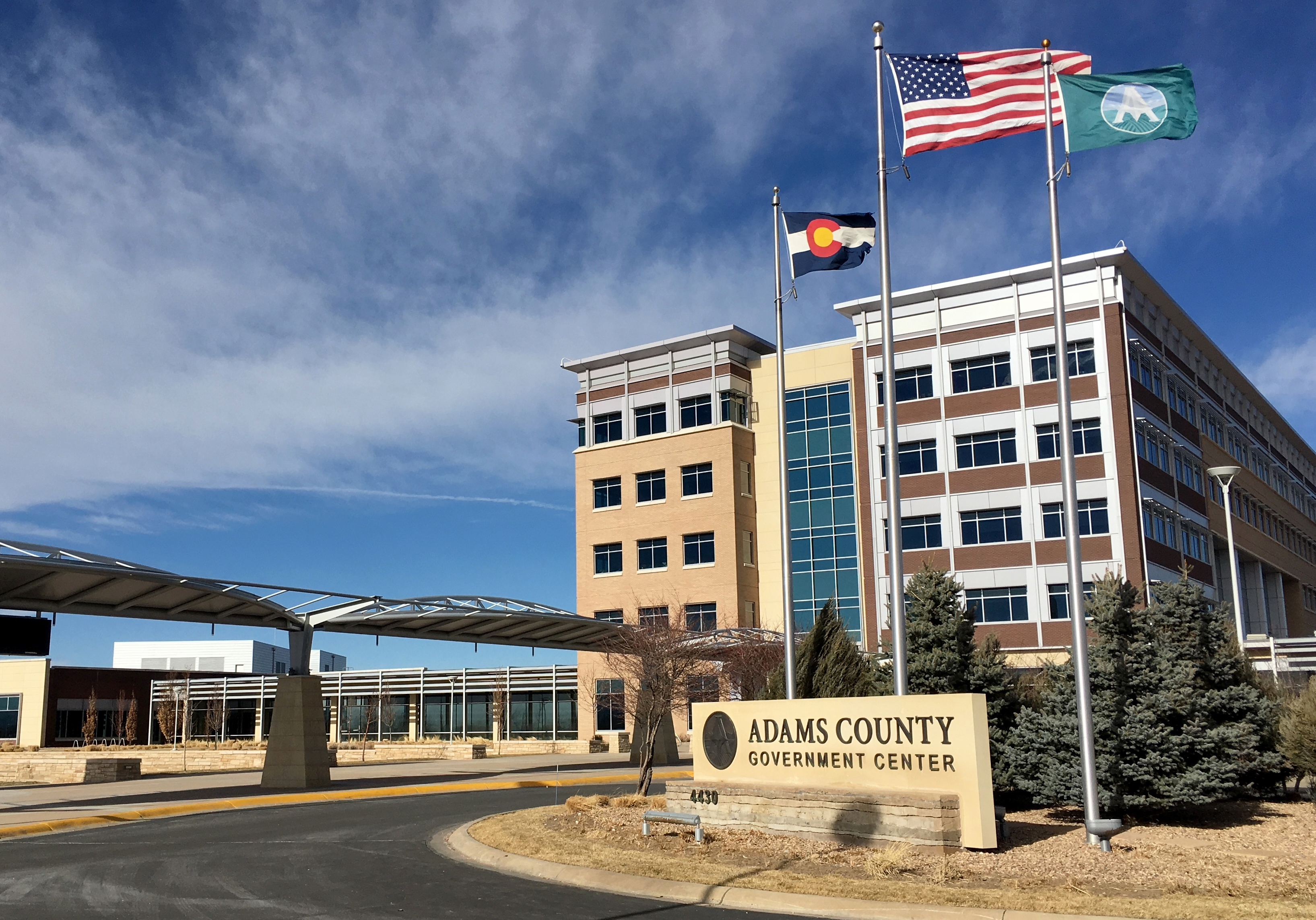
Adams County is a county government in the Denver metropolitan area, county seat Brighton, founded 1901. It buys through the Board of County Commissioners, with the Finance Department's Purchasing Division as the issuing office. Rebekah Zamora-Arroyo, Contract Specialist II, is the named contact and signer. The RFI gathers market input on a cloud budgeting platform; no award is made from it.
Adams County Government Center, Brighton, Colorado. Photo via the County. Population figures are public-source estimates.
From the prime-contractor database. A few enterprise vendors dominate the revenue total at parent-company scale, but the field runs long and the in-state presence is real. Figures are public-source estimates for partner targeting.
Map the response heading-for-heading to these. The pricing structure is high-level and non-binding at this stage.
Questions the prime should consider, in writing, by the June 12 deadline. Keep them constructive and market-informing. Techtiz never contacts the County.
The unnamed ERP defines the single most technically specific clause and the biggest pricing variable.
What is being replaced shapes the migration and the implementation approach.
User count drives both the SaaS line and the training program size.
The rollout model changes the timeline, the risk profile, and the change-management cost.
Under NDAMulti-year historical migration is a major cost driver worth scoping early.
Under NDAThe County is undecided. A constructive question here helps shape the RFP without overstepping.
Under NDATechtiz writes the response and builds the platform in vendor-hosted or synthetic environments. The prime owns the ERP access, the county data, the submission, and every word said to the County.
An NDA covering the RFI contents, the internal pricing and strategy, and the work product, for at least three years.
Each capability area mapped to a platform feature, the ERP researched from public records, the pricing range what we built flagged assumptions.
The demonstration environment and platform configuration on vendor-hosted or synthetic data, never against county systems.
ERP access, county data, the platform submission, and any future contract all stay with the prime.
Tender Insight, Tender Abstract, Summary of Procurement, the Statement of Work, and the U.S. primes database. A US partner manager replies within one business day, under a mutual NDA, never agency-facing.
Quick answers about how to use this engagement example and what detail is available under NDA.
Most SLED subcontract work sits under mutual NDA and prime branding requirements. Public summaries describe engagement type, technical surface, and outcomes. Partner names and proposal content are shared only with explicit written permission or under an executed teaming agreement.
Yes. If your pursuit matches this engagement type, email sled@techtiz.co or use the teaming intake form. Within 1 business day a U.S.-based partner manager replies with a mutual NDA template and a calendar slot—never agency-facing.
Full RFP-decode packs, compliance matrices, technical volumes, submission runbooks, and named-resume options scoped to your vehicle and timeline. Prime name, pricing, and agency data stay inside the prime boundary.
No. Techtiz is subcontract-only and never faces the agency. Your program manager holds the client relationship, sign-off, and all agency communication.