
We map the workflow first: every step, who touches it, how often it fails, and what the exception path is. Automating a broken process gives you a broken process running faster, with a new layer of tooling nobody wants to unpick later.
SERVICE 05 · AUTOMATION AND SYSTEMS
Automation that pays for itself, and proves it
Techtiz builds workflow automation on n8n, Make, and the tools you already run: sales, CRM, support, and back-office flows. We map the process first, wire the integrations, and instrument hours saved so finance can read the payback instead of taking it on faith.
Process mapped first Payback instrumented Monitored on retainer
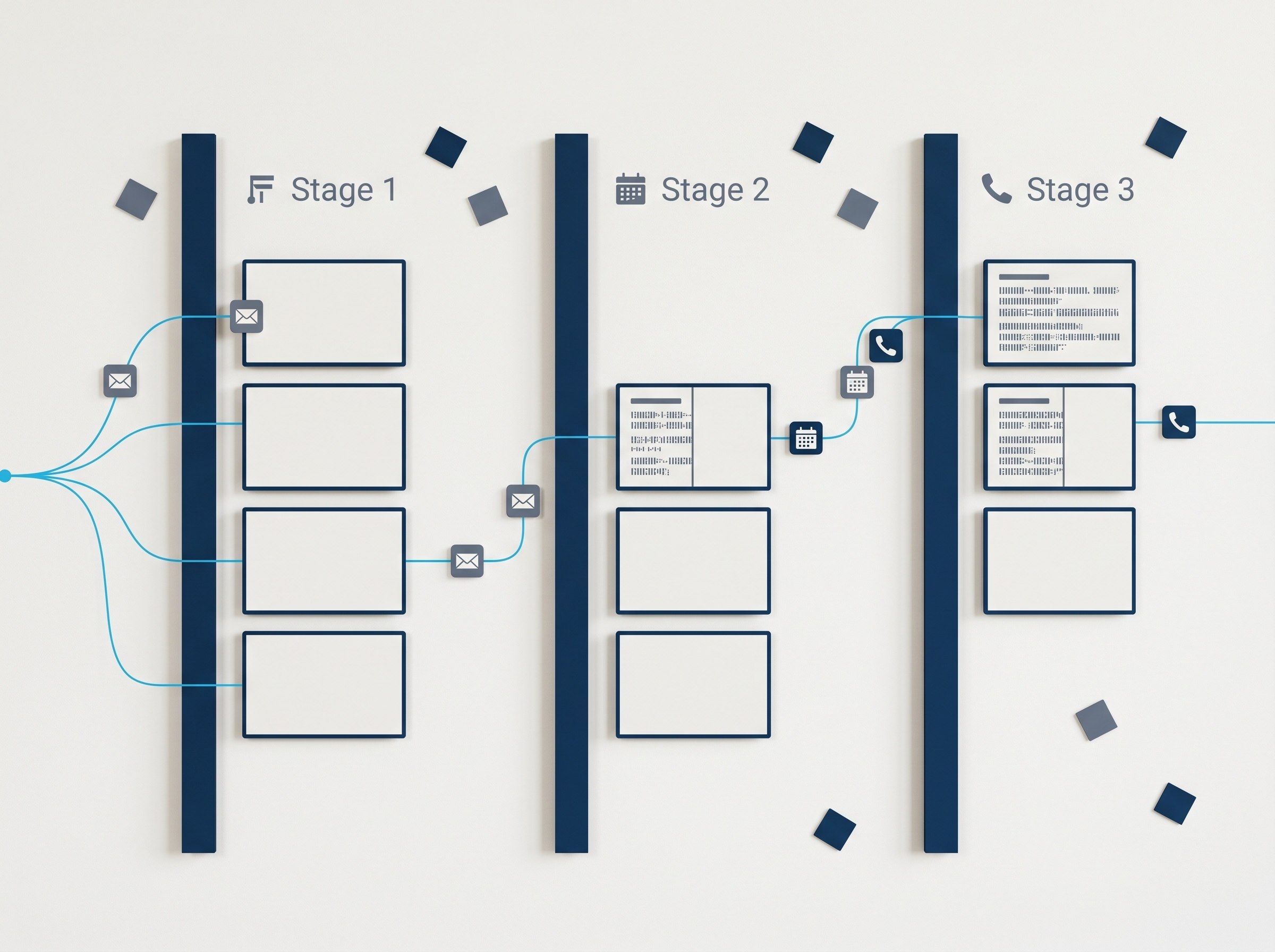
THE BACK OFFICE IS WHERE THE MONEY IS
Underfunded, and where the highest returns sit
MIT's enterprise AI research found the highest measured returns concentrated in back-office automation, which is where the least budget goes. The budget goes to sales and marketing pilots. For a 50 to 500 person company the arithmetic is simple: find the workflows a person repeats daily, wire them, and count the hours. We put a counter on every automation we ship so the payback is a report, not a feeling.
Source: MIT Project NANDA, 2025.
WE MAP THE PROCESS FIRST
Automating a broken process gives you a broken process, faster
Sometimes the finding is that 3 steps should be deleted rather than automated, and that is the cheapest recommendation in the engagement.
WHAT WE AUTOMATE
6 categories, 1 senior bench
Lead routing and follow-up.
Quote and proposal generation.
Support triage and ticket enrichment.
Invoice and reconciliation flows.
CRM hygiene and reporting.
Marketing operations.
Platforms
n8n Make GoHighLevel Bitrix24 Zoho HubSpot
 n8n
n8n  Make
Make  GoHighLevel
  HubSpot
 THE PAYBACK COUNTER
What every automation carries
Runs
Executed, logged and alertable per automation.
Items
Processed, counted against your measured baseline.
Exceptions
Escalated, never silently dropped.
Hours
Returned, measured against a before you agreed to.
The baseline is measured with you, before launch, in your systems, and the assumption is written down so you can argue with it. Monthly payback report, 1 page, written for a finance reader.
WHAT BREAKS, AND WHAT HAPPENS WHEN IT DOES
4 causes, none of them exotic
An upstream tool changes its API or UI
Monitoring catches the failed run, we are alerted, fix inside the response window.
Credentials or tokens expire
Alerted before expiry where the platform exposes it, immediately on failure where it does not.
Data arrives in an unexpected shape
The run halts and routes to an exception queue rather than writing bad data.
Rate limits or volume spikes
Backoff and queueing, with an alert if the backlog crosses a threshold.
Retainer clients get monitoring on every workflow, alerting to your channel, a named response window agreed in the contract, and a monthly improvement block. Without a retainer you get runbooks and alerting, and the honest statement that when it breaks on a Friday it is your team fixing it. There is no version where an automation quietly fails for 3 weeks and nobody notices.
WHEN AN AUTOMATION SHOULD BECOME AN AI WORKER
The promotion signal is specific
Some automations outgrow their rails. The workflow starts needing judgment, exceptions multiply, or the rules change faster than anyone can maintain them. The signal: the method has stabilised but the inputs never do. When we see it we say so, and the workflow moves to the agentic engineering line carrying the specification, the logs, and the instrumentation it already earned. Nothing is rebuilt from zero.
Nothing gets promoted to an agent because agents are fashionable. If deterministic rules still handle 95% of your cases, deterministic rules are cheaper, faster, and easier to audit, and we will say so.
N8N, MAKE, OR ZAPIER
We will tell you which, and why
n8n
Complex logic, self-hosting, high volume, and custom code steps. Low and flat cost when self-hosted, but you are running infrastructure.
Make
Fast builds on standard SaaS connectors. Operation-priced, and the tier jump at scale is the thing to watch.
Zapier
Simple flows and teams already living in it. Task-priced and climbs fastest.
In writing, at your volume. If Zapier is genuinely the right answer for a 40-run-a-month workflow, that is the answer and it does not need us to maintain it.
WE DO NOT REPLACE YOUR CRM
Rip and replace is a last resort
Rip and replace is a last resort, not a sales strategy. Most automation value is available inside the CRM you already run, and the migration you were quoted is often a workflow problem wearing a platform costume.
WHAT WE WILL NOT AUTOMATE
The no list
A process nobody can describe end to end. We will map it first, as a paid piece of work.
Approval steps that exist for a compliance reason, without your compliance owner signing off on the automated version.
Anything that would write to a system of record without a reconciliation path.
A workflow that should be deleted. We will say so.
Ownership
Your repositories, your IP, assigned on payment, from day 1.
Exit
30 days notice on anything monthly. Handover runbook included, not quoted separately.
Overlap
4+ hours of daily overlap with your working day, contractual.
Boundary
Work performed in Lahore by Techtiz personnel under a US-formed Wyoming LLC. Regulated data classes stay on your side and we design around that.
Named engineer
1 senior engineer accountable for the estimate, on the first call.
Sourced claims
Every non-obvious statistic on this site carries a named third-party source and a date.
For U.S. SLED prime contractors
Back-office automation, delivered as your subcontractor.
If your SLED scope includes process automation or systems integration, we build it behind the prime. The boundary is fixed on purpose.
NAICS 541511 541512 541519
See SLED Subcontracting NDA-first, subcontract-only. We work behind the prime, under your brand. We do not pursue prime contracts and we never face the agency.
Secure API handling. Strict data governance and clear human-in-the-loop exception routing, the controls a procurement security review asks for.
Capability over claims. Workflow orchestration (n8n, Make) and ERP integration mapped to your bid's technical scope.
FAQ
The questions you were going to ask
What breaks, and who fixes it?
Four causes and the response for each are published on the page. On retainer, us, inside an agreed window. Off retainer, your team, with runbooks and alerts.
Can I prove the payback to my CFO?
Yes. That is what the baseline measurement and the monthly 1-page report are for.
Will you try to sell me an agent?
Only when the promotion signal appears. If deterministic rules still handle your cases, we say so and keep taking the smaller retainer.
Do we own the automations?
Yes. Exported, documented, and yours. On self-hosted n8n they run on your infrastructure.
Can you automate our CRM without replacing it?
Yes. Rip and replace is a last resort.
Start the conversation
Tell us the workflow someone repeats every day
That is where the first automation goes, and where the payback counter starts.